Los Perales: an architectural heritage
Original article - Liliana Elguezabal - September 2020
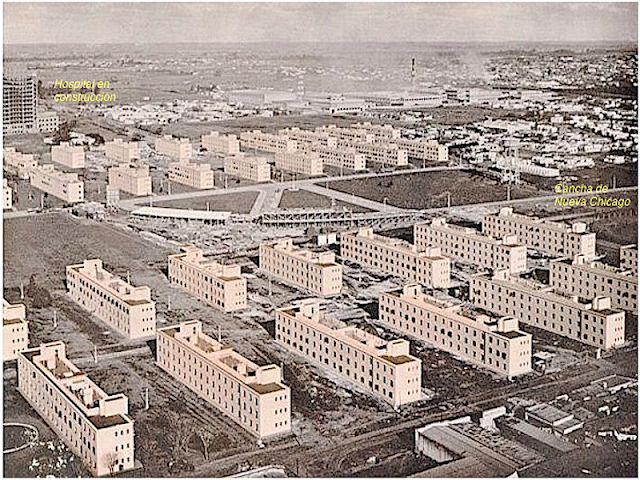
On Avenida Eva Perón and Lisandro de la Torre, opposite the Nueva Chicago field, the emblematic club of Mataderos, there is another significant space for the history and present of the neighborhood: Los Perales.
The cornerstone of this social housing project, one of the most important of the Peronist government, was laid on September 13, 1947, in a ceremony led by the Minister of Public Works, Guillermo Borda. It was completed in September 1949, when the Justicialist School was inaugurated alongside the housing units.
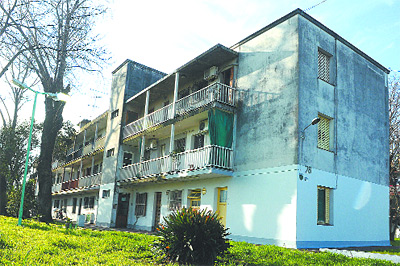
The neighborhood consists of 45 three-story buildings with 1,068 apartments: 888 with two bedrooms and 180 with three bedrooms. These are low, elongated blocks or rows situated in a landscaped area with dense trees. It includes a civic center with shops, a school, a library, and a sports complex. The land area is 200,000 square meters. The blocks or rows were built with reinforced concrete structures and masonry walls. Their appearance, with unadorned facades, reflects the rationalist style.
It was built as part of the Eva Perón Housing Plan, under the jurisdiction of the Municipality of the City of Buenos Aires, with funds from the National Mortgage Bank. Through this plan and other projects, nine neighborhoods were developed in the city, each with different urban planning criteria and architectural styles. Of the pavilions in Los Perales, 39 were built during the Peronist era and six were added during the Frondizi administration.
Although there is a history of state-built housing, it was in the 1940s that the housing deficit and the living conditions of the popular sectors became a social issue.
National Law 9677, enacted in 1915, created the National Commission for Low-Cost Housing, tasked with addressing the needs of workers. However, between that year and 1943, only 977 homes were built.
Between 1943 and 1955, housing entered the public agenda as a fundamental aspect of social justice, but also as a key element in the economic policy that promoted the development of national industrial capital. Within the framework of the First and Second Five-Year Plans, the construction sector was promoted due to its capacity to generate employment, demand inputs, and create fixed capital. Affordable credit was established as a means of income redistribution. Along the same lines, the 1949 Constitutional reform incorporated, along with other social rights, the Right to Housing in Article 14 bis and addressed in Chapter IV "The social function of property, capital, and economic activity."
In 1948, the enactment of Law 13,512 completed the regulatory framework to facilitate access to housing, by allowing the subdivision of buildings into horizontal property, the acquisition by tenants of the homes they rented, and investment in housing construction in all urban centers.
In 1955, with the coup d'état known as the Liberating Revolution, which overthrew Perón, the Los Perales neighborhood was renamed Manuel Dorrego, and the Justicialist School, Roma. This highlighted the discrimination against its residents, who were labeled "cabecitas negras" (little black heads) because of their humble origins, and the neighborhood itself as a "nest of Peronist rats."
Law 4874, passed by the Buenos Aires City Legislature on December 5, 2013